Tuesday, 26 January 2021

तस्विरकाे

 कल्पना तस्विरकाे,

झझल्को तस्विरकाे

रातदिन अाउने याद तस्विरकाे ।।

फेसबुक तस्विरकाे, 

माया तस्बिरकाे,

छाँया तस्विरकाे,

एकान्तलाई याद दिने साथ तस्विरकाे ।।

माेह तस्विरकाे,

शक्ति तस्विरकाे,

भक्ति तस्विरकाे,

अाशक्ति मेटाउने बात तस्विरकाे ।।

अाँखामा बस्ने तस्विरकाे,

अाँखावाट विलाउने तस्विरकाे,

मुटुमा तिर छाड्ने तस्विरकाे,

पिर छाड्ने तस्विरकाे,

हर बखत विझाउने घात तस्विरकाे ।।

Saturday, 23 January 2021

Characterstics Demand Model

K. Lancaster has applied the indifference curves approach to develop a new theory of con­sumer demand, viz., the product characteristics theory. Lancaster’s product characteristics/attributes model is essentially a theory of consumer behavior that shows how consumers choose between a number of brands of a product, each of which of­fers a particular product characteristic in fixed pro­portions. For example, a consumer buying mixed fruit juice may be looking for two principal characteris­tics—flavor and vitamin content.

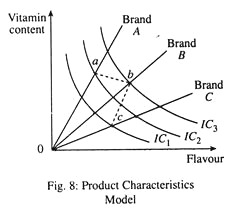
Three brands of such juice are available—Brand A, Brand B and Brand C—each of which is differentiated insofar as it places a different emphasis on the two product characteris­tics. The three brands are represented by the rays in Fig. 8, each of which shows the fixed proportion of product characteristics in each brand. Brand A, for example, has high vitamin content but little flavor, while Brand C, by contrast, has a lot of flavor but a low vitamin content.

Product Characteristics Model

Points a, b and c on these rays show how much of each brand of juice can be bought for a given unit of expenditure at the prevailing prices of the three brands. To find the consumer’s utility-maximizing brand purchases, it is necessary to introduce a set of indifference curves such as IC1, IC2 and IC3, showing the consumer’s preferences between the two product characteristics. The consumer’s final choice will be Brand B, as it settles at point b on the highest attainable indifference curve IC3 consistent with the limited expenditure.


Wednesday, 20 January 2021

Financial Derivative Instrument

Derivatives

  •         A derivative is a financial contract that drives it value from an underlying asset.
  •         The buyer agrees to purchase the assets on a specific date at specific price.
  •        The assets include commodities stock bond interest rate and currencies.
  •         Derivatives can be used either for risk management or for speculation (Hedging).

Types of Derivatives

A. Futures

  •    A future contract is an agreement between two parties to buy or sell on assets at a certain time in the future at certain prices.
  •     Future contract to hedge against risk or peculate n the price movement of the underlying assets.
  •         Future are standardized contracts traded on a centralized exchange.
  •         It can be called bet between two parties.

B. Forwards

  •     A forward contract is a non-standardized contract between two parties to buy or to sell an asset at a specific future time at a price agreed upon today.
  •        The key difference being that unlike future, forward contract is not traded on stock exchange, rather only over the counter market.
  •     Forwards are used to hedge risk in commodities, interest rate, exchange rate or equities.

C. Swap

  •         A swap is most often a contract between two parties’ agreement by to trade loan terms.
  •         One might use an interest rate swap to switch form a variable interest rate loan too fixed interest rate loan or vice versa.
  •         If a person might seek to switch their variable interest rate loan with some else, who has a loan with a fixed interest rate that tis otherwise similar.
  •       The loan will remain in the original holder’s name, the contract mandate that each party will make payment towards the others loan at a mutually agreed upon rate.
  •      A swap can be risky, because if one party defaults or goes bankrupt, the others will be forced back into their original loan.
  •         Swap can be made using interest rate, currencies or commodities.

D. Option

  •    An option is similar to a future contract in that is an agreement between two parties garneting one the opportunity to buy or sell a security from or to the others party at a predetermined future date.
  •     The key different between option and future is that option simply gives the buyer the option to their buy or sell the assets at a certain price and date.

Types of Option

1.    Call option – buyer has option for buy or not.
2.    Put option- seller has option for sell or not.

Types of option on the basis of American and European

1.    American options- it is exercise before maturity.
2.    European option- it is exercise on the date of maturity. 

Friday, 8 January 2021

आमा छोराको सपना

धेरै हेर फेर गर्नू छैन जिन्दगीमा, केबल....

 जागिरबाट पाएको पहिलो तलबले आमासंग मुक्तिनाथ हेर्नु छ ।

बर्साै देखिको आमाको फाटेको सारी फेर्नु छ ।।

मेरा लागि गरेको दुःख रोक्दै, अव आमाको जिवन शैली फेर्नु छ ।।।

दुःख र सपनाले भरिएका आमाको अनुहारमा चम्किलो प्रकाश झल्केको हेर्नुछ ।।।।

शिशिरे जाडोमा फुटेको उनका हातहरुमा मलम लगाई छाला फेर्नु छ ।।।।।


म भन्दा मेरी आमा खुसी हुनेछिन,

फोन गरेर आमा मैले जागिर पाएँ भन्दा,

आँशु बर्रर हुनेछन उनका,

आजबाट काममा लाएँ भन्दा ।।।।।


आफ्नो भन्दा पनि छोराले दुःख पायो भन्ने छ उनलाई,


मलाई मेरो जागिर भन्दा पनि मलाई जागिरले दिने खुसी महत्वपुर्ण छ ।  जुन आमाको अनुहारमा दखिन्छ । त्यो खुसी चाँढै देख्न पाउँ ।

Friday, 1 January 2021

तिम्रो फोटो हेर्दा हेर्दै बेटरी लो हुन्छ,

 तिम्रो फोटो हेर्दा हेर्दै बेटरी लो हुन्छ,

एक छिन हेरेर चार्ज गर्छु भन्छु...

चार्ज सकिन्छ अनि मात्र थाह पाउँछु । 

मोवाइल अफ भएपनि,

फोटो आँफै चले जस्तो लाग्छ, बोले जस्तो लाग्छ ।

खै के हो जादु, तिमीलाई हेर्दा हेर्दै ढले जस्तो लाग्छ ।

#nightmood